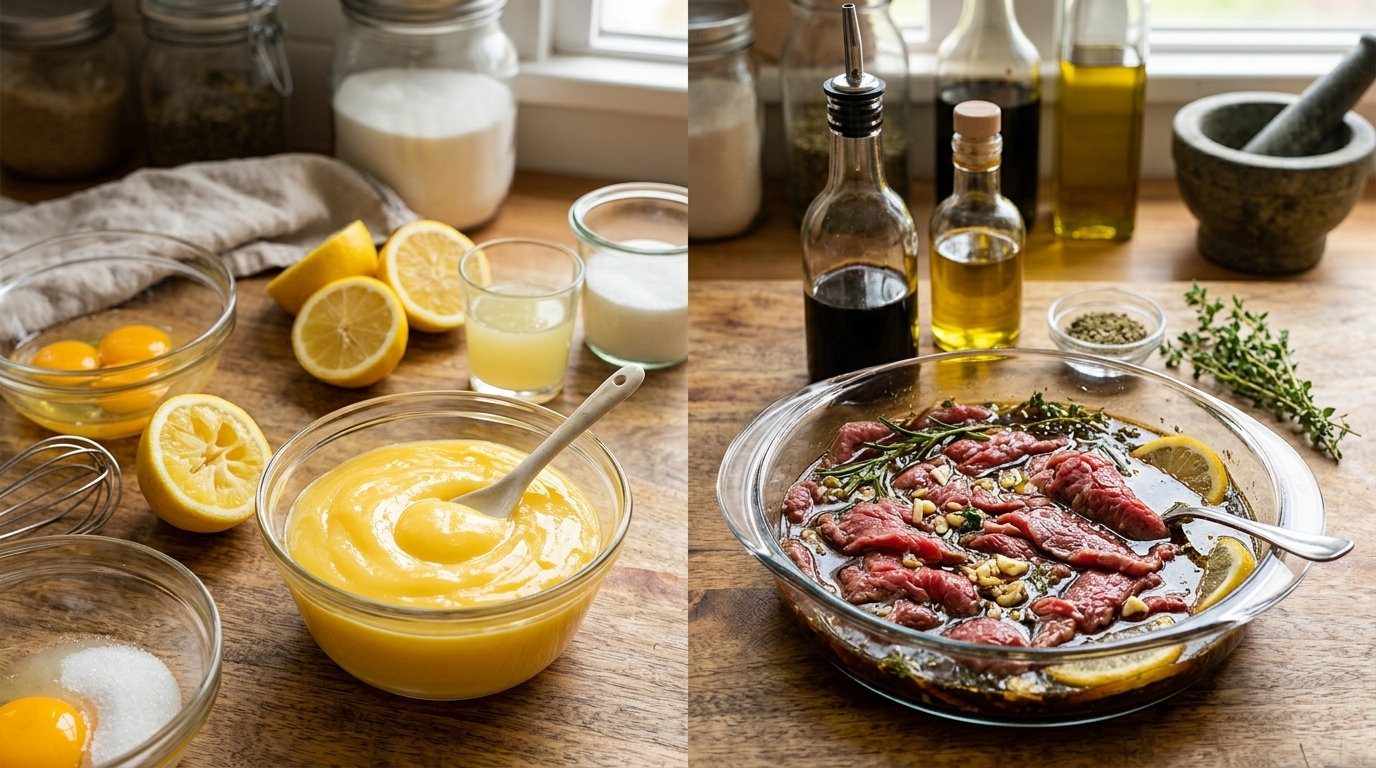
pH is one of the quiet control systems in cooking. It shapes how ingredients taste, how proteins set, how moisture is retained, how batters rise, how vegetables soften, and how stable emulsions and foams remain. In practical terms, pH affects brightness, tartness, bitterness, tenderness, firmness, browning, and thickening. Low-pH ingredients such as lemon juice, vinegar, yogurt, and buttermilk alter flavor and structure in ways that are predictable once the chemistry is understood.
That predictability matters most in dishes where small changes in acidity produce large changes in outcome. Lemon curd depends on acid for controlled egg coagulation. Marinades use acid to modify the surface proteins of meat, but the result depends on acid type, concentration, salt, and time. The same broad mechanism—acid affecting proteins and water behavior—can create a smooth custard-like curd in one context and a dry, crumbly exterior in another.
For readers who want to go deeper into reaction mechanisms, acid-base behavior, and step-by-step chemistry explanations behind cooking processes, Chemistry AI Helper offers guided support for equations, reactions, and theory. It accepts typed or uploaded chemistry questions and provides step-by-step explanations across organic, inorganic, physical, and analytical chemistry.
What does pH mean in cooking, and why does it matter for flavor and texture?
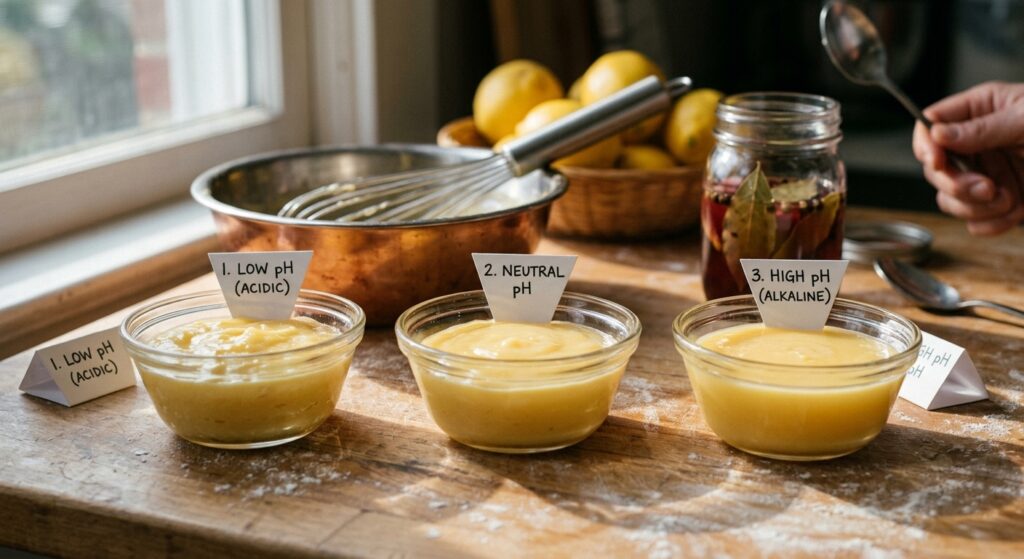
pH measures how acidic or alkaline a system is, and in cooking that measurement has direct consequences for proteins, starches, pectin, pigments, and leavening reactions. The result is not abstract chemistry; it determines whether food tastes bright or flat, whether a custard thickens smoothly or curdles, whether vegetables stay firm or turn soft, and whether a batter rises as intended.
Acidic conditions are associated with low pH. In the kitchen, that usually means ingredients such as citrus juice, vinegar, yogurt, buttermilk, or other fermented and sour components. Serious Eats describes acid in cooking as a low-pH ingredient that adds brightness, sharpens sweetness by contrast, reins in bitterness, and makes food taste fresher and more complete.
Alkaline conditions move recipes in a different direction. Baking soda raises pH, accelerates browning, and changes texture by affecting pectin, proteins, and starch behavior. Serious Eats notes that baking soda can help break down pectin on the surface of potatoes for extra-crispy roasting, while also accelerating browning in baked goods; Open Textbooks for the Canadian Baker likewise explains that lactic acid can coagulate dairy proteins into a gelled consistency, showing how pH shifts texture on both the acidic and alkaline sides.
Why does acid make food taste brighter, fresher, or more balanced?
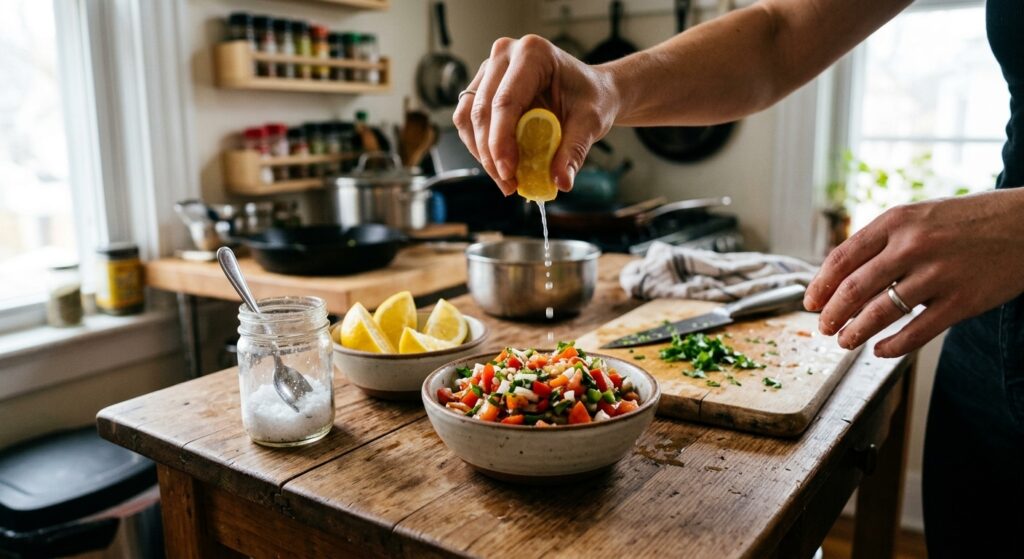
Acid increases contrast. It does not merely make food sour; it changes the way sweetness, bitterness, richness, and saltiness are perceived on the palate. That is why a small amount of lemon juice, vinegar, or another acid can make a finished dish taste sharper, cleaner, and more defined without changing the core ingredients.
Serious Eats states that acid sharpens sweetness by contrast, reins in bitterness, and helps food taste fresher and more complete. The timing of acid also matters: adding lemon juice earlier produces a mellower, more integrated acidity, while adding it at the end creates more obvious brightness and lift. That timing difference explains why the same ingredient can either disappear into the structure of a sauce or stand forward as a finishing note.
This sensory effect is central to both savory and sweet cooking. In chocolate cake, Serious Eats found that natural cocoa, which is more acidic, produced a brighter and fruitier chocolate profile than Dutch-process cocoa, which is alkalized and tastes deeper and smoother. In vegetables, low-pH finishing ingredients preserve freshness and perceptual clarity. In rich foods, acid counterbalances fat. The common factor is not style of dish but pH-driven contrast.
How does acidity change texture in cooking?
Acidity changes texture by changing molecular structure. It can denature proteins, shift coagulation behavior, alter water retention, stabilize or destabilize foams, slow or accelerate the breakdown of plant cell-wall materials depending on the system, and influence how starches and gluten behave in batters and doughs.
Protein systems show this clearly. Open Textbooks reports that separated egg white coagulates at 60–65°C (140–149°F) and yolk at 62–70°C (144–158°F), while egg-milk-sugar mixtures such as custards thicken at 80–85°C (176–185°F) and start to curdle at 88–90°C (190–194°F). Those numbers show that structure depends not only on heat, but also on what else is in the mixture. Sugar, fat, water, and acid change the conditions under which proteins set.
Acid can also stabilize foam systems. Serious Eats found that in aquafaba meringues, the low pH from cream of tartar helped modify protein structures to create a stable foam that aerated well and held its shape, while also reducing browning from caramelization and Maillard reactions. That is a different cooking system from curd or meat, but the same principle applies: pH changes structure, and structure changes texture.
Plant structure responds differently. Serious Eats explains that acidic cooking environments help vegetables retain firmness and shape by slowing pectin breakdown, while alkaline environments speed pectin breakdown and soften vegetables more quickly. That contrast matters because it shows there is no single rule such as “acid softens food.” In vegetables, acid tends to preserve firmness; in egg-based mixtures, acid can promote controlled thickening; in meat, the outcome depends on acid type and exposure time.
Why does lemon curd thicken instead of turning into scrambled eggs?
Lemon curd works because acid, egg yolks, sugar, butter, and controlled heat are aligned toward one outcome: smooth coagulation. The acid from lemon juice denatures egg proteins, sugar moderates how quickly they link together, butter contributes richness and emulsion-like smoothness, and gentle heating keeps the protein network fine rather than coarse.
Appeasing a Food Geek describes the sequence directly: after sugar and eggs are mixed, acid begins to unfold or denature the proteins; those proteins then connect and capture liquid in coagulation, and sugar acts as a buffer to prevent curdling. That buffering role is the difference between a curd that thickens progressively and one that races toward scrambled eggs.
The temperature window matters. Custard-style systems thicken between 80°C and 85°C (176–185°F) and begin to curdle above that range, according to Open Textbooks. Lemon curd lives in that same structural territory. The cook is not trying to “cook eggs” in the ordinary breakfast sense; the cook is trying to create a dense but fine protein network that traps water, dissolved sugar, and fat without squeezing them out.
The ingredient proportions also show what the system is doing. In the cited lemon curd formula, the core structure comes from lemon juice, egg yolks, sugar, and butter. That combination is not accidental. Egg yolks provide proteins and emulsifying components, lemon juice provides both acidity and flavor, sugar influences viscosity and coagulation behavior, and butter rounds out texture. Remove the acid and the dish loses both its defining taste and the specific coagulation pathway that produces curd rather than sweet scrambled eggs.
What does acid actually do in a marinade?
In marinades, acid acts first at the surface. It denatures proteins, changes water behavior, and can alter tenderness, firmness, juiciness, and cooking loss. It does not penetrate muscle tissue infinitely or transform all cuts in the same way, and the type of acid matters as much as the presence of acid itself.
Nik Sharma’s Serious Eats experiments compared three common culinary acids in marinades: acetic acid from vinegar, citric acid from citrus, and lactic acid from yogurt or other fermented dairy systems. All three are sour, low-pH, and capable of denaturing proteins, but they do not produce the same textural result in cooked meat. Sharma reports that chicken marinated with lactic acid was more tender; citric acid produced a slightly firmer texture; and acetic acid produced the toughest and crumbliest texture.
The lamb results were similarly directional. Sharma found that lactic acid-marinated lamb gained more weight during marination and lost less weight during cooking than lamb marinated in acetic acid, with citric acid also outperforming acetic acid on those measures. He also reports that overnight yogurt marination reduced the time needed to cook lamb to a tender texture from about one and a half hours to around 40 minutes in his test recipe. Those observations matter because they connect pH not only to tenderness but also to water retention and cooking efficiency.
This is why the standard phrase “acid tenderizes meat” is incomplete. Acid can improve tenderness, but it can also produce a firmer, drier, or crumbly surface when the acid is harsher or the exposure is excessive. The right question is not whether a marinade contains acid, but which acid, in what matrix, with what salt level, on what protein, for how long.
Are all acids the same in cooking, or do different acids behave differently?
Different acids behave differently because chemical structure affects how they interact with food systems. In cooking, the most practical comparison is among citric acid, lactic acid, and acetic acid, because each is common in recipes and each produces distinct flavor and texture effects.
Serious Eats identifies three common cooking acids: acetic acid in vinegar, citric acid in lemons and limes, and lactic acid produced by fermentation. In Sharma’s marinade experiments, lactic acid was the gentlest on meat texture, citric acid was intermediate, and acetic acid was the harshest. That hierarchy is important because it explains why yogurt marinades often tolerate longer resting times than vinegar-heavy marinades.
The food matrix matters too. Yogurt is not just “acid in water.” It is an acidic dairy system with proteins, solids, and viscosity. Lemon juice is a thin citrus system dominated by water, dissolved acids, and aromatic compounds. Vinegar is a different low-pH liquid again. When cooks substitute one for another without adjusting time or expectations, they often misread the result as inconsistency rather than chemistry.
Citric acid also appears in pastry and modernist contexts beyond simple sourness. Open Textbooks notes that citric acid can be used as a preservative and acidulant, helps enhance flavors, and is used in modern cooking as an emulsifier aid and acid buffer in techniques such as spherification. That broader functionality reinforces the central point: acids are not interchangeable flavor notes; they are structural ingredients.
Why does pH help lemon curd succeed but make marinades harder to control?
Lemon curd is a closed, highly constrained system. Its variables are limited, the protein source is uniform, the heat is controlled, and the target texture is a smooth thickened gel-like emulsion. Marinades are open, variable systems: the protein source changes by cut and species, acids differ in strength and behavior, salt modifies the response, and time can move the surface from beneficial denaturation into textural damage.
In lemon curd, acid is not a side ingredient. It is part of the design. The acid denatures yolk proteins, sugar buffers the process, and the mixture is heated through the exact temperature range where thickening occurs before curdling begins. The cook’s task is precision.
In marinades, acid is one variable among several, and the target is less exact. A marinade may aim for flavor absorption, surface conditioning, moisture retention, tenderness, or browning support. Those goals can conflict. Sharma’s results show that lactic acid can improve juiciness and tenderness while acetic acid is more likely to push texture toward crumbly toughness. That means control comes from matching acid type to the protein and marination time, not from maximizing sourness.
The contrast between these two dishes is the best practical lesson in culinary pH. Low pH is not inherently good or bad for texture. It is useful when it is synchronized with the structure you want.
How does pH affect baking, browning, and leavening beyond curds and marinades?
pH has direct effects on carbon dioxide production, crumb structure, cocoa flavor, browning rate, and color. Acid-base balance in baking is one of the clearest examples of kitchen chemistry translating into visible structural outcomes.
Serious Eats explains that mixing baking soda with acidic ingredients such as buttermilk, yogurt, or vinegar produces carbon dioxide, which causes batters to rise. Baking soda is pure sodium bicarbonate and alkaline; beyond lift, its alkalinity accelerates browning reactions and deepens color and flavor. Baking powder contains both bicarbonate and a powdered acid, so it is less dependent on external acidity.
Cocoa is a precise case study. Serious Eats reports that natural cocoa is acidic, with a pH of approximately 5–6, while Dutch-process cocoa is alkalized to approximately pH 6.8–8. In recipes relying heavily on baking soda and cocoa as an acid source, switching from natural cocoa to Dutch-process cocoa can alter crumb, rise, color, and flavor. Natural cocoa yields a brighter, fruitier chocolate profile and red-brown hue; Dutch-process cocoa yields a darker color and smoother, deeper flavor.
These examples broaden the article’s main point. pH changes flavor and texture not only in obviously sour foods, but also in cakes, cookies, foams, noodles, vegetables, and browned foods where the acid or alkali is structural rather than dominant in taste.
How can you use acidity more effectively in everyday cooking?
Use acid according to function. If the goal is brighter flavor, add it late or in a finishing role. If the goal is structural change, add it where the recipe depends on it—during curd making, in the marinade stage, or in the batter where leavening chemistry requires it. Serious Eats explicitly notes that lemon juice added earlier tastes more integrated, while lemon added at the end tastes brighter.
Choose acid type deliberately. For meat marinades, yogurt-based lactic acid systems are gentler than vinegar-based acetic acid systems in Sharma’s tests, with better moisture retention and more favorable texture outcomes. For pastry, citrus provides both acid and specific aroma compounds. For baking soda-leavened batters, ensure the formula includes enough acid to generate carbon dioxide and control pH.
Treat more acid as a directional change, not a universal improvement. More acid can sharpen flavor, but it can also push a system out of balance. In meat, too much exposure can worsen texture. In custard-like systems, too much heat after thickening begins can move the network from smooth to curdled. In vegetables, acid may preserve firmness when softness is desired. Correct use depends on the desired endpoint, not on the ingredient’s popularity.
How do you troubleshoot recipes when acidity seems to be the problem?
Start by identifying whether the defect is sensory, structural, or both. A dish that tastes dull may need finishing acid. A curd that is grainy or split is usually a coagulation-control problem. A marinated protein that is tough, crumbly, or mushy reflects the wrong acid system, too much exposure, or both.
For lemon curd, the critical variables are temperature, sugar distribution, and gentle mixing. The cited food-science explanation is explicit: acid denatures the proteins, sugar buffers them, and coagulation must be controlled. Once the mixture passes from thickening into curdling temperature, texture deteriorates.
For marinades, evaluate acid identity first. A yogurt marinade and a vinegar marinade are not equivalent, even if both taste sour. Sharma’s findings give a practical ranking for meat texture in his tests: lactic acid was gentlest, citric acid intermediate, and acetic acid harshest. That ranking is more actionable than the generic advice to “use acid carefully.”
For baked goods, check the acid-base pair. If a batter depends on baking soda, the formula needs sufficient acidity to produce carbon dioxide and manage crumb structure. Serious Eats’ cocoa testing shows that changing the acidity source can shift not only flavor but also texture and rise.
The working rule
Use pH as a control variable, not as a flavor afterthought. In lemon curd, low pH supports controlled coagulation. In marinades, low pH must be matched to the right acid type and time window. In baking, pH determines how soda reacts, how cocoa behaves, and how crumb develops. In vegetables and foams, pH decides whether structure is retained or broken down. Once those systems are separated conceptually, acidity stops feeling intuitive and becomes precise.
About Post Author